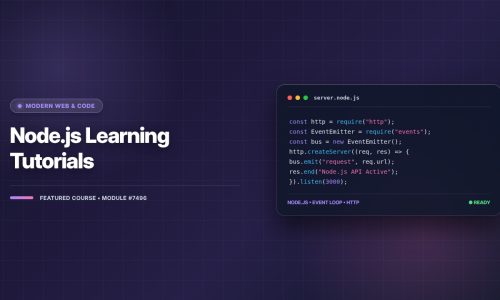
Welcome to the Node.js Tutorials course! This thorough guide helps you master the fundamentals of Node.js, one of the most powerful and widely used JavaScript runtimes for building scalable server-side applications. Whether you’re just getting started with Node.js or an experienced developer going deeper, this course gives you a solid base and practical skills.
Course Goals
- Understand Node.js architecture and core concepts.
- Learn to set up and configure your development environment.
- Build your first Node.js application from scratch.
- Master module creation, loading, and management in Node.js.
- Explore essential built-in modules like
Path,OS, andEvents. - Work with asynchronous programming using callbacks, promises, and event-driven patterns.
- Get hands-on experience with HTTP requests and responses.
By the end of this course, you’ll be confident building robust, efficient, scalable Node.js applications.
Course Outline
1. Introduction to Node.js
- Node.js Architecture:
Dive into Node.js’s core architecture — its single-threaded event loop, non-blocking I/O, and the role of the V8 engine. - How Node.js Works:
Grasp the key principles behind Node.js, such as event-driven programming and the use of callbacks and promises. - Installing Node.js:
Learn to install Node.js on your machine, set up the environment, and verify the install.
2. Getting Started with Node.js
- Your First Node App:
Create your first “Hello, World!” app to see how Node.js executes and outputs. - Globals in Node.js:
Explore global objects and variables available in Node.js, such asglobal,process, andrequire.
3. Modules in Node.js
- Modules in Node.js:
Understand the module concept in Node.js, including CommonJS and ES6 module systems. - Creating a Module in Node.js:
Learn to build custom modules and organize your code cleanly. - Loading (Requiring) a Module in Node.js:
Discover how to import and use modules in your Node.js apps. - The Module Wrapper Function:
Dive into how the module wrapper works under the hood and how it encapsulates your code.
4. Built-in Modules
- The Path Module in Node.js:
Work with file paths and directories using thepathmodule. - The OS Module in Node.js:
Interact with operating-system details and utilities using theosmodule.
5. Events and the Event Emitter
- Events and Event Emitter in Node.js:
Understand Node.js’s event-driven nature and how to use theEventEmitterclass to handle events. - Event Arguments:
Learn how to pass and handle arguments when emitting and listening for events.
6. The HTTP Module
- The HTTP Module in Node.js:
Build simple HTTP servers and clients with the built-inhttpmodule. Handle requests and responses to create basic APIs.
Who Should Take This Course?
- Frontend Developers expanding into backend development.
- JavaScript Developers who want to use their existing knowledge to build server-side apps.
- Beginners new to Node.js but comfortable with JavaScript basics.
- Intermediate Developers who want a deeper grasp of Node.js architecture and best practices.
What You’ll Need
- A computer with internet access.
- Basic JavaScript knowledge (variables, functions, loops, etc.).
- A text editor or IDE (e.g., VS Code, Sublime Text).
- Node.js installed on your machine (instructions included in the course).
What You’ll Learn
- Understand Node.js’s core principles and ecosystem.
- Set up and run a Node.js development environment.
- Create and manage modules in Node.js.
- Use built-in modules like
path,os, andeventseffectively. - Build simple HTTP servers and handle requests and responses.
- Apply event-driven programming to real problems.
Course Format
- Video Lectures: Clear, concise tutorials with live coding.
- Hands-On Exercises: Practice by building small projects and applications.
- Quizzes and Challenges: Test your understanding through interactive quizzes and coding challenges.
- Support and Resources: Additional resources, documentation, and community support.
Why Learn Node.js?
- High Performance: Node.js is known for speed and efficiency, ideal for real-time apps.
- Scalability: Its non-blocking I/O model handles thousands of concurrent connections.
- JavaScript Everywhere: Write both frontend and backend in JavaScript, cutting context switching.
- Rich Ecosystem: Access thousands of npm packages for all kinds of uses.
Next Steps
Ready to dive into Node.js? Start with the Node.js Architecture lesson to understand the foundation of this powerful runtime. By the end of the course, you’ll be ready to build your own Node.js apps and take your web development skills further!
Let’s get started — the future of server-side JavaScript is waiting!
Curriculum
- 1 Section
- 14 Lessons
- 14 Weeks
- Node.js Learning Tutorials14
- 1.1Inside the Node.js Architecture4 Minutes
- 1.2How Node.js Actually Works5 Minutes
- 1.3Setting Up Node.js3 Minutes
- 1.4Writing Your First Node Application3 Minutes
- 1.5Global Objects in Node.js4 Minutes
- 1.6Understanding Node.js Modules4 Minutes
- 1.7Building a Custom Node.js Module5 Minutes
- 1.8Importing (Requiring) a Module in Node.js6 Minutes
- 1.9The Module Wrapper Function Explained5 Minutes
- 1.10Working with the Path Module in Node.js5 Minutes
- 1.11Working with the OS Module in Node.js5 Minutes
- 1.12Events and the Event Emitter in Node.js7 Minutes
- 1.13Using the HTTP Module in Node.js
- 1.14Passing Event Arguments4 Minutes
Instructor